Technical Specification & Thermal Design Data Sheet
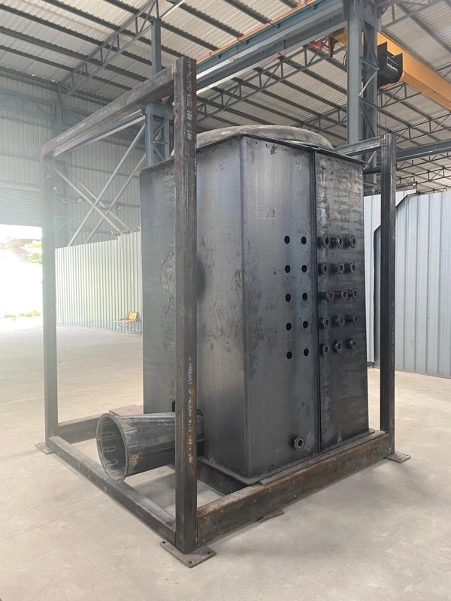
System Designation: Heat Cell 550 Thermal Energy Storage Unit
Document Type: Core Mechanical & Thermodynamic Engineering Specification
Operational Classification: High-Throughput Daily Cyclic Storage (8h Charge / 16h Discharge)
1. System Mass & Sensible Energy Balance
Core Metallic Matrix: 3,200 kg high-temperature FeCrAl/austenitic structural alloy mass.
Internal Structural Frame & Core Baffles: 500 kg integrated support structure and primary internal flow baffles (3,700 kg total internal metallic thermal mass).
Nominal Dynamic Temperature Range: 1,000∘C maximum fully charged state to 100∘C high-grade process discharge baseline (extended 50∘C–30∘C low-grade hydronic extraction).
Sensible Heat Capacity (Q): 550 kWh baseline (1,000∘C→100∘C); 598 kWh total sensible capacity (1,000∘C→30∘C).
2. Geometry, Enclosure Architecture & Insulation Envelope
Primary Core Matrix Dimensions: Cylindrical profile, ∅1,400 mm×2,300 mm length.
Primary Structural Enclosure: 1,500 mm×1,500 mm×2,400 mm steel container backfilled with high-purity alumina ceramic insulation.
Outer Barrier Enclosure: 1,600 mm×1,600 mm×2,500 mm heavy-gauge double-skinned steel outer shell incorporating an integrated 25 mm perimeter convection air gap.
Minimum Radial Barrier Depth (d insulation): 170 mm minimum continuous depth across all side-wall pinch-points; 250 mm+ effective depth at corner profiles.
4. Required Performance Validation Outputs
The following baseline performance envelope defines the target operational parameters across an active 24-hour cycle (8 hours full charge at 1,000∘C, 16 hours linear energy extraction):
Peak Equilibrium Thermal Loss (kW): Steady-state dissipation rate under maximum thermal loading (Tcore=1,000∘C.
Target Bound: Lower Bound: 2.1 kW | Upper Bound: 2.5 kW
Integrated 24-Hour Energy Loss (ΔQloss): Total cumulative energy rejected to ambient across the 24-hour transient cycle.
Target Bound: Lower Bound: 30 kWh | Upper Bound: 35 kWh
Net Round-Trip Thermal Efficiency (ηthηth): Ratio of delivered thermal energy to total stored thermal energy (Qdelivered/Qtotal).
Target Bound: Lower Bound: 94.0% | Upper Bound: 95.5%
Outer Skin Temperature Profile (Tcasing): Surface temperature map across outer casing faces, pinch-points, and corners under peak core thermal load.
Target Bound: Lower Bound: 35°C | Upper Bound: 50°C (ISO 13732-1 touch safe)
Control of Output Temperature and Flow Control: Constant or variable flow and temperature, numerical control over two valves and blower speed.
Operational Target: Stepless modulation across 100–1,000 m3/hmass flow rate delivering 100°C–850°C process temperature output.
5. ESG & Sustainability Impact Overview
1. Zero Critical Mineral Risk: Built entirely from abundant, non-toxic structural metals and high-purity alumina ceramic oxides—eliminating cobalt, lithium, and rare-earth supply chain and mining vulnerabilities.
2. Direct Fossil Fuel Displacement: Delivers direct high-temperature industrial heat up to 1,000∘C, replacing gas boilers and heavy burners where chemical batteries cannot compete.
3. Ultra-Fast Carbon Payback: The embodied carbon of the 3.7-tonne metal core is fully offset within 60 to 90 days of active industrial operation.
4. Flexible Renewable Integration: Powered by charging sources from, but not limited to, solar and wind—solving curtailment and aligning with heavy industrial load curves.
5. Zero Capacity Degradation: 20+ year asset life (7,300+ deep daily cycles) with 94%–95.5% round-trip thermal efficiency and near-zero standby losses.